 Hover to zoom
Custom Corrugated Box Dividers Cut to Fit Your Box
From £0.25 per unit Price confirmed on your written quote
Corrugated dividers split a box into separate cells so bottles, jars and parts cannot knock together. Tell us the box inside size and the number of cells, and we will quote dividers alone or with a matching box.
Quick answer
What are corrugated box dividers?
Corrugated box dividers are strips of corrugated board with slots cut halfway through. The strips slide into each other to form a grid of cells inside a box. They protect glass, keep sets in order and stop small items rattling.
Key facts
- Slotted strips form a grid
- Any number of cells
- Single or double wall
- Supplied alone or with a box
- From £0.25 per unit
- Free digital proof
Corrugated Box Dividers specifications
18 rows| Style | Interlocking slotted partitions forming a grid of cells |
|---|---|
| Layout | From two cells in a row up to many cells in a grid |
| Typical board | E flute, B flute or C flute single wall; BC double wall for heavy glass |
| Height | Usually the full inside height of the box, or a shorter height for low items |
| Fit | Cut to the inside size of your box |
| Variants | Single row dividers, full grids and punched holders for vials |
| Usually plain; print available when dividers show on opening | |
| How it ships | Flat strips, slotted together by hand |
| Board options | Single wall B, C or E flute; double wall BC flute; kraft or white folding board |
| Printing | Plain, one or two colour, or full colour CMYK; inside and outside print available |
|---|---|
| Finishes | Uncoated kraft, matte or gloss lamination, spot UV, foil stamping, embossing |
| Sizes | Made to your inside length, width and height in mm, cm or inches |
| Artwork files | PDF, AI, EPS or SVG preferred; high-resolution PNG or JPG accepted |
| Design help | Free layout help from our design team |
| Proof | Free digital proof before anything is printed |
| Production | 4–6 business days after proof approval |
| Delivery | Tracked, 2–3 business days; free across the UK |
| Misprints | Reported within 10 days with photos: reprinted or refunded |
Common layouts
| Cells and typical cell size | Good for |
|---|---|
| 3 cells, about 100 × 100 mm each | Three candles or jars in a gift box |
| 5 slots in a single row | Bottles of sauce, oils or nail polish |
| 3 × 4 grid, about 70 × 70 mm cells | Twelve small jars, mugs or spice tins |
| 4 × 4 grid, about 60 × 60 mm cells | Sixteen candles, samples or parts |
| 2 × 3 grid, about 90 × 90 mm cells | Six wine or beer bottles |
What are corrugated box dividers?
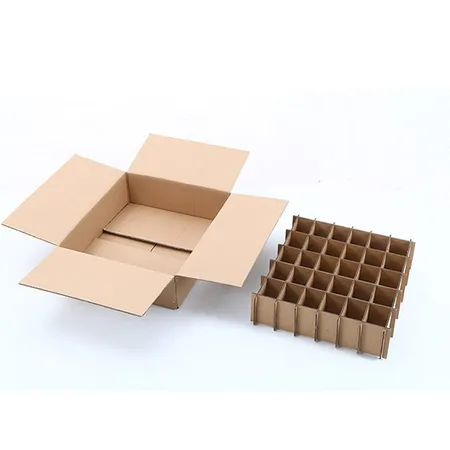
They are flat strips of corrugated board cut with slots. Each strip slots into the strips running the other way, and the result is a grid that stands up inside a box.
The grid turns one open box into many small compartments. Every item has its own space, so nothing touches its neighbour.
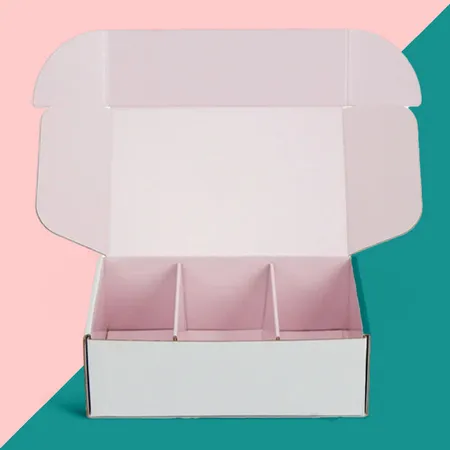
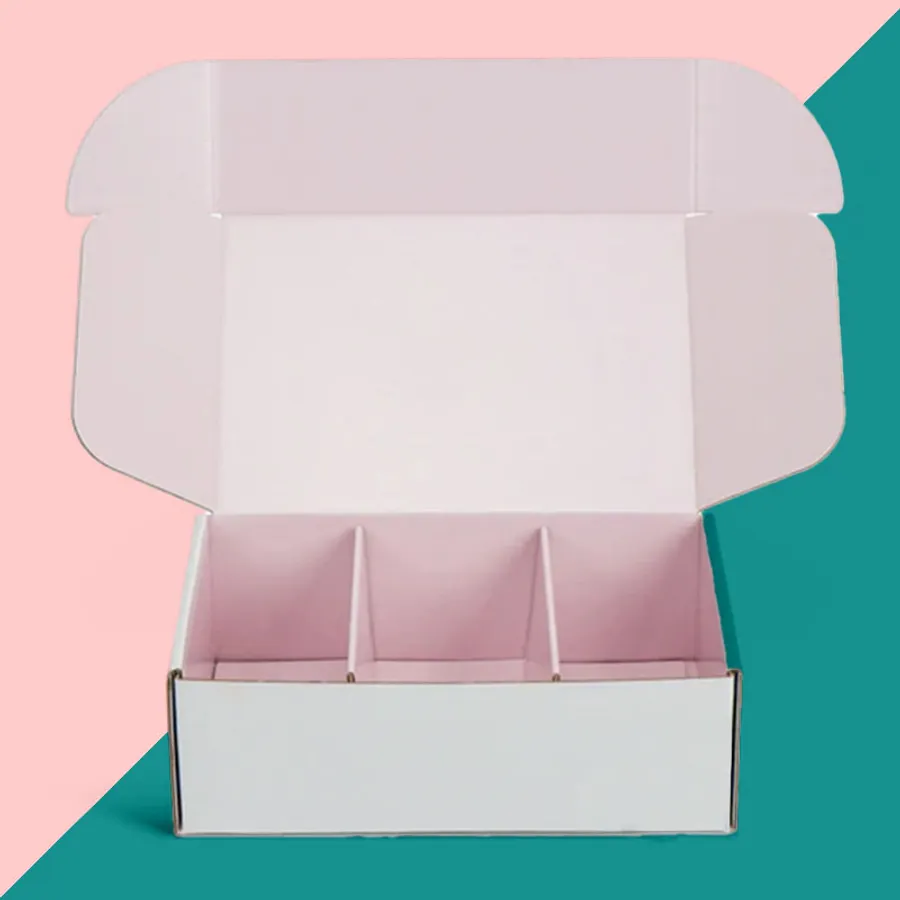
Our photos show grids of three, five, twelve and sixteen cells inside mailer boxes. There is also a punched corrugated holder with six round holes for small bottles or vials.
Who orders box dividers?
Anyone packing several of the same item into one box, especially if those items are glass or easy to scratch.
Dividers also save time at the bench. Instead of wrapping every item in paper, staff drop each one into its cell and close the box.
- Drinks makers sending bottles of beer, cider, juice or spirits
- Candle makers shipping glass jars in sets
- Food producers packing sauces, oils, honey and preserves
- Cosmetics brands sending sample sets and polish bottles
- Workshops and warehouses sorting spare parts and fixings
Which type of divider do I need?
The layout depends on what you pack and how heavy it is. This table covers the common options.
| Type | How it works | Good for |
|---|---|---|
| Single row divider | One long strip with cross pieces | Bottles or tubes in a line |
| Full grid | Strips cross both ways | Jars, mugs, tins in sets |
| Low-height grid | Shorter strips than the box | Flat or short items in rows |
| Punched holder | Board with round holes | Vials, test tubes, small bottles |
| Grid in a matching box | Dividers sized with the box | A full set ready to pack |
How do I measure for box dividers?
Start with the inside length, width and height of the box the dividers will go in. If you are ordering the box from us too, we size both together.
Then measure the widest point of one product. Each cell should be a few millimetres larger so items slide in without forcing.
Remember that every divider wall takes up space. In B flute each wall adds about 3 mm, so a row of four cells needs about 9 mm more than the products alone.
Finally, count how many items you want in each row and column. Our guide to taking inside box measurements explains where to place the tape.
Which board should the dividers be?
Light items, such as sample bottles, are fine with E flute at about 1.5 mm. It is thin, so it leaves more room for the products.
For jars and standard bottles, B flute at about 3 mm or C flute at about 4 mm gives a firmer wall between cells. Most beer and sauce bottle dividers fall into this range.
Heavy glass, such as wine bottles, suits double wall BC board at about 7 mm. It adds cushioning as well as strength, and pairs well with a double wall outer box.
The board for the dividers does not have to match the outer box. A double wall outer carton with single wall dividers inside is a common pairing for jars.
If you are unsure, send a photo of the product and its weight. We will suggest the flute on the quote and explain the reason in a line or two.
Should box dividers be printed?
Most dividers are left plain, because they sit inside the box and are mainly there to protect. Plain kraft is the most common choice.
If the dividers show when the box is opened, as in a gift set, printing can be worth it. We print one colour, two colour or full colour CMYK, and white board gives a clean look like the pink-lined box in our photos.
Finishes such as lamination or foil are rarely needed on dividers. Save those for the outer box.
One useful middle ground is a single colour number or label on each cell. It helps pickers fill mixed sets in the right order.
Packing tips
Assemble the grid on a flat table first, then lower it into the box in one piece. Trying to build it inside the box usually ends with a bent strip.
Load the heaviest items into the corner cells first. That keeps the box balanced while you fill the middle.
If you pack mixed sets, tape a filled example to the bench wall. New staff can copy the layout without asking.
For glass, wrap each bottle neck with a little paper if it rises above the divider height. Close the box and give it a gentle shake to check nothing rattles.
Mistakes to avoid
A few measuring and planning slips cause most divider problems.
- Measuring the outside of the box rather than the inside
- Making cells exactly the product size, so items jam
- Using thin E flute for heavy glass bottles
- Choosing dividers shorter than the bottle's shoulder, so necks knock together
- Forgetting the base needs padding under heavy items
Can I order dividers on their own?
Yes. If you already have boxes, send us their inside size and we will cut dividers to fit them.
It helps to measure two or three of your boxes, not just one. Boxes from different batches can vary by a millimetre or two, and dividers should suit the snuggest of them.
Many customers order the box and dividers together, though. Sizing both at once avoids gaps and saves a measuring step.
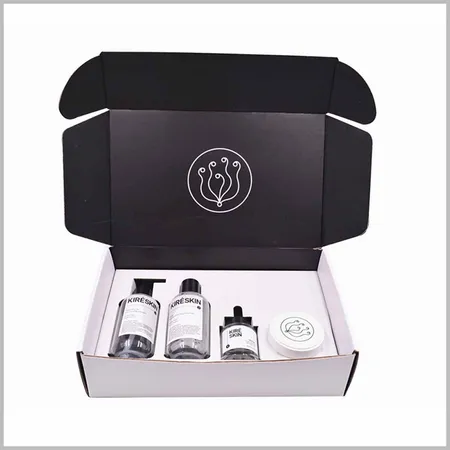
Mailer boxes with built-in grids, as in our photos, are a neat option for sending sets by post. See mailer boxes with fitted inserts for that style.
How do dividers protect glass?
A common cause of breakage in a box of bottles is glass striking glass. A divider wall between them removes that contact.
The corrugated fluting also gives a little cushion. When the box is bumped, the board flexes slightly instead of passing the knock straight through.
Add a layer of board or paper under the grid for extra protection at the base.
Dividers also help the box itself. The grid braces the side walls from inside, so a filled box keeps its shape better when another box is stacked on top.
How to order corrugated box dividers
We deliver dividers free to any address in the UK. If dividers arrive damaged or cut wrongly, photos within 10 days get them reprinted or refunded.
- Send the box inside size, or ask us to quote a box and dividers together.
- Tell us the product size and how many cells you need in rows and columns.
- Choose E, B, C flute or BC double wall, or ask for a suggestion.
- Receive a written quote, from £0.25 per unit.
- Approve the free digital proof, which shows the grid layout and any print.
- Dividers are cut in 4–6 business days, followed by tracked delivery in 2–3 business days.
Corrugated Box Dividers: questions
12 answersWhat are box dividers called?
They are also known as partitions, cell dividers or bottle dividers. All describe slotted strips that form compartments inside a box.
Can you make dividers for my existing boxes?
Yes. Send the inside size of your box and we will cut dividers to fit.
How many cells can a divider have?
Anything from two cells upwards. Common layouts include 3, 6, 12 and 16 cells.
What board is best for wine bottles?
Double wall BC board, about 7 mm thick, is a good choice for heavy glass like wine bottles.
Do the dividers come assembled?
No. They arrive as flat strips and slot together by hand in a few seconds.
Can dividers be shorter than the box?
Yes. Low-height dividers suit short items, though for bottles they should rise above the shoulder.
Can you print on box dividers?
Yes, though most are left plain. Print is worth it when the dividers show as part of a gift set.
Can I order the box and dividers together?
Yes, and many customers do. We size both together so the fit is right.
Do dividers work in mailer boxes?
Yes. Our photos show several mailer boxes with grids inside, which suit candles, jars and sample sets.
What about holders for small vials?
A punched corrugated holder with round holes is an option for vials and small bottles.
How much do box dividers cost?
Prices start from £0.25 per unit and are confirmed on a written quote.
What if the dividers do not fit?
Send photos within 10 days. If they were cut wrongly or arrived damaged, we reprint or refund.
Not covered here? Message the trade desk on WhatsApp or email info@ordercardboardboxes.co.uk.
Design Your Box
Choose a box from the photos, place your logo on it, pick the print and send it. We turn it into a free print-ready proof.
1Choose a box
2Place your logo
Upload a logo to see it on the box
Selected: Corrugated Box Dividers
Send us the full brief
Give us the size, the board and the print. A packaging specialist replies within one business day with a written price and a free digital proof.
- Free digital proof before anything is printed
- Production 4–6 business days after proof approval
- Free tracked delivery across the UK