 Hover to zoom
Custom Chipboard Dividers for Vials, Bottles and Small Parts
From £0.25 per unit Price confirmed on your written quote
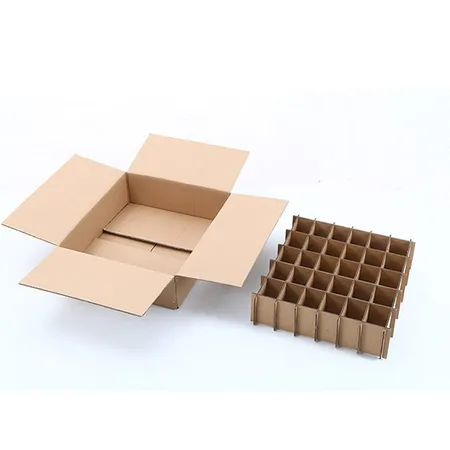
Chipboard dividers are thin card partitions that slot together into a grid of small cells. We cut them from kraft or white folding board to fit the inside of your box, with as many cells as your items need.
Quick answer
What are chipboard dividers?
Chipboard dividers are slotted strips of thin folding board that lock together to form a grid inside a box. Each cell holds one small item upright, such as a vial, test tube or sample bottle. They take up less room than corrugated partitions, so more cells fit in the same box.
Key facts
- Thin card, more cells per box
- Kraft or white folding board
- Dense grids of small cells
- Slots together by hand
- From £0.25 per unit
- Free digital proof
Chipboard Dividers specifications
18 rows| Style | Interlocking slotted strips forming a square or oblong grid |
|---|---|
| Board | Kraft folding board or white folding board |
| Cell count | From a short row of cells to a tight 10 × 10 grid |
| Height | Full box height, or lower so caps sit above the grid |
| Fit | Made to the inside length, width and height of your box |
| Box option | Supplied alone or with a matching mailer or lidded box |
| Usually plain; print on request | |
| How it ships | Flat strips in bundles, assembled by hand |
| Board options | Single wall B, C or E flute; double wall BC flute; kraft or white folding board |
| Printing | Plain, one or two colour, or full colour CMYK; inside and outside print available |
|---|---|
| Finishes | Uncoated kraft, matte or gloss lamination, spot UV, foil stamping, embossing |
| Sizes | Made to your inside length, width and height in mm, cm or inches |
| Artwork files | PDF, AI, EPS or SVG preferred; high-resolution PNG or JPG accepted |
| Design help | Free layout help from our design team |
| Proof | Free digital proof before anything is printed |
| Production | 4–6 business days after proof approval |
| Delivery | Tracked, 2–3 business days; free across the UK |
| Misprints | Reported within 10 days with photos: reprinted or refunded |
Common chipboard grid layouts
| Grid and typical cell size | Good for |
|---|---|
| 5 × 5 grid, cells about 30 × 30 mm | Essential oil and dropper bottles |
| 9 × 9 grid, cells about 20 × 20 mm | Sample vials and lab tubes |
| 10 × 10 grid, cells about 25 × 25 mm | A hundred small parts or test pots |
| 4 × 6 grid, cells about 40 × 40 mm | Nail varnish, tea lights or spice jars |
| Single row of 6 cells | Sauce samples or slim bottles in a line |
What are chipboard dividers?
Chipboard dividers are partitions made from thin, flat card rather than fluted board. Each strip is cut with slots halfway down its height. Strips running one way slide into strips running the other way, and a stiff grid stands up inside the box.
Because the card is thin, the walls between cells take up very little space. A box that would hold a 6 × 6 corrugated grid can often hold a much denser chipboard grid instead.
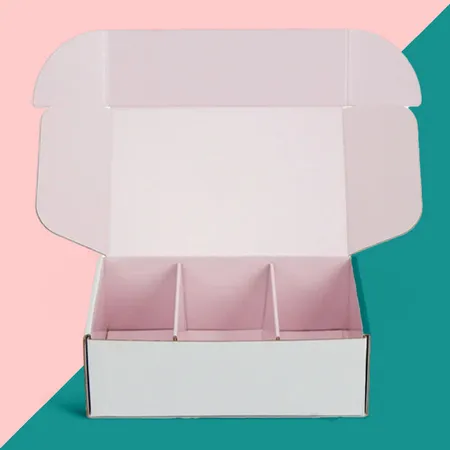
Our photos show kraft grids of around a hundred cells inside mailer boxes, plus a white grid set in a white lidded box. They sit within our wider packing supplies and box inserts range.
Who uses chipboard dividers?
Anyone who ships or stores lots of small, upright items in one box. The common thread is that each item is light, and it must not roll into its neighbour.
Schools and hobby groups use them too. A gridded box keeps paint pots, crayons or seed packets in order between sessions.
- Labs and clinics storing sample vials and test tubes
- Aromatherapy brands packing 10 ml dropper bottles
- Nail and beauty sellers shipping bottles of varnish
- Craft shops sorting beads, buttons and thread reels
- Engineering firms keeping small fittings apart
- Candle makers sending sets of tea lights or tins
Chipboard or corrugated dividers: which do I need?
Weight is the deciding factor. Thin card works well when each item is light and the box is not dropped from height. Heavier glass, such as wine bottles or jam jars, needs the cushioning of fluted board. For those, look at our fluted corrugated box dividers instead.
| Point | Chipboard dividers | Corrugated dividers |
|---|---|---|
| Wall thickness | Thin card | About 1.5 to 4 mm fluted board |
| Cells per box | More, packed tightly | Fewer, with thicker walls |
| Item weight | Light items | Light to heavy items |
| Shock cushioning | Low | Higher, thanks to the flutes |
| Look on opening | Neat and fine | Chunkier, more rugged |
How do I measure for a chipboard grid?
Start with the inside of the box, not the outside. Measure the inside length and width at the base, then the inside height. Our guide on how to measure a box properly explains the difference.
Then measure one item at its widest point. A round bottle is measured across its body, or across the cap if that is wider. Add 2 to 3 mm so it drops in without forcing. Multiply that cell size by the number of cells in each row, and check the total fits the box.
Finally, decide on grid height. A grid at full box height steadies tall bottles. A lower grid leaves caps and labels showing, which makes picking quicker.
Which board suits chipboard dividers?
We cut chipboard dividers from kraft folding board or white folding board. Kraft has a warm brown look and hides small marks well, so it suits storage and trade packs.
White board looks clean and clinical. It suits lab samples, skincare sets and gift boxes where the grid shows as soon as the lid comes off. It also makes handwritten cell numbers easy to read.
Both boards fold cleanly at the slots and stay flat in the bundle. If the grid will be handled often, as in a parts store, pick kraft. If it is mainly seen once at unboxing, white usually wins.
Can chipboard dividers be printed?
Most dividers are left plain, because the items inside do the talking. Print is still possible when the grid is part of the unboxing.
We can print one colour, two colour or full colour CMYK on the strips. A simple use is a row of numbers or letters along the top edge, so each cell has a reference. Our designers set this up free and send a digital proof before production.
How do I put a chipboard grid together?
Grids arrive as flat bundles of long and short strips. Assembly takes a minute once you have done one.
- Lay out the long strips with their slots facing up.
- Hold the short strips with their slots facing down.
- Push each short strip onto the long strips at the matching slots.
- Check every crossing is pushed fully home so the top edge is level.
- Lower the finished grid into the box and press it to the base.
Packing tips for small items in a grid
Fill the outer cells first. They take the knocks when a box is handled, so a full outer ring keeps the grid square.
Lay a flat sheet of card over the tops before closing a tall box. It stops bottles lifting out of their cells if the parcel turns upside down. For extra cushion under the base, a thin layer of crinkle paper works well.
Pack one test box before a full run. Shake it gently, turn it over and open it again. If any item has moved or a cell wall has bowed, the cell size or board needs a change.
Common mistakes with chipboard dividers
The first mistake is measuring the item label instead of its widest part. A bottle that fits by its body can still jam by its cap.
The second is asking thin card to carry heavy glass. If one full cell feels heavy in the hand, move up to corrugated board. Last, people forget that the grid walls take a little space. Add their thickness when you work out the overall grid size, or let us do the sums.
Can a chipboard grid go into a box I already use?
Yes, and this is how many orders start. You already have a box that works, but items rattle around inside it. Send us the inside size of that box and we cut a grid to drop straight in.
If you are still choosing a box, it is easier to size both together. We can make a matching printed or plain mailer box with the grid fitted to it. That way the cell rows line up exactly with the walls, and there is no gap at the edges.
Keep a note of the box size and grid layout once you are happy. Repeat orders are then quick, because the sizes are already settled.
How do I order chipboard dividers?
Prices start from £0.25 per unit, and your written quote confirms the exact figure. Send us the box inside size, the cell layout, the board colour and the quantity. Use the trade quote form for inserts, or email info@ordercardboardboxes.co.uk. WhatsApp is fine too.
We send a free digital proof first. Production takes 4 to 6 business days after you approve it. Tracked delivery then takes 2 to 3 business days, and UK delivery is free. If anything arrives damaged or misprinted, send photos within 10 days and we reprint or refund.
Chipboard Dividers: questions
12 answersWhat is the difference between chipboard and corrugated dividers?
Chipboard dividers are thin flat card, so more cells fit in a box. Corrugated dividers use fluted board and cushion heavier items better.
How many cells can a chipboard grid have?
Grids range from a single short row up to dense layouts such as 10 × 10. The limit is the box size and the size of each item.
Will chipboard dividers hold glass bottles?
They suit small, light glass such as vials and dropper bottles. Larger or heavier glass is safer in corrugated dividers.
Can you make the box as well as the dividers?
Yes. We can quote the grid on its own or with a matching mailer or lidded box made to size.
Do the dividers come assembled?
No. They arrive as flat slotted strips, which saves space, and they slot together by hand in a minute or two.
Can I have white chipboard dividers?
Yes. White folding board gives a clean look for lab samples, skincare and gift sets.
Can the grid be shorter than the box?
Yes. A lower grid leaves caps showing so items are easier to lift out.
Can you print numbers on each cell?
Yes. We can print references along the strip edges so each cell has its own number or letter.
What do I need to measure?
The inside length, width and height of the box, plus the widest point of one item, including its cap.
Are chipboard dividers good for storing parts?
Yes. They keep screws, fittings, beads and similar small parts sorted in one box on a shelf.
Will I see a proof first?
Yes. You get a free digital proof showing the grid layout, and we only cut after you approve it.
How long do chipboard dividers take?
Production is 4 to 6 business days after proof approval, then 2 to 3 business days for tracked delivery.
Not covered here? Message the trade desk on WhatsApp or email info@ordercardboardboxes.co.uk.


Design Your Box
Choose a box from the photos, place your logo on it, pick the print and send it. We turn it into a free print-ready proof.
1Choose a box
2Place your logo
Upload a logo to see it on the box
Selected: Chipboard Dividers
Send us the full brief
Give us the size, the board and the print. A packaging specialist replies within one business day with a written price and a free digital proof.
- Free digital proof before anything is printed
- Production 4–6 business days after proof approval
- Free tracked delivery across the UK