Box guide
Cardboard Box Sizes in the UK
Common UK box sizes in millimetres and inches, and how to choose the right one for your goods.
Is there a standard cardboard box size in the UK?
No single size is official. Instead, a handful of sizes turn up again and again because they suit common goods, paper formats and pallets.
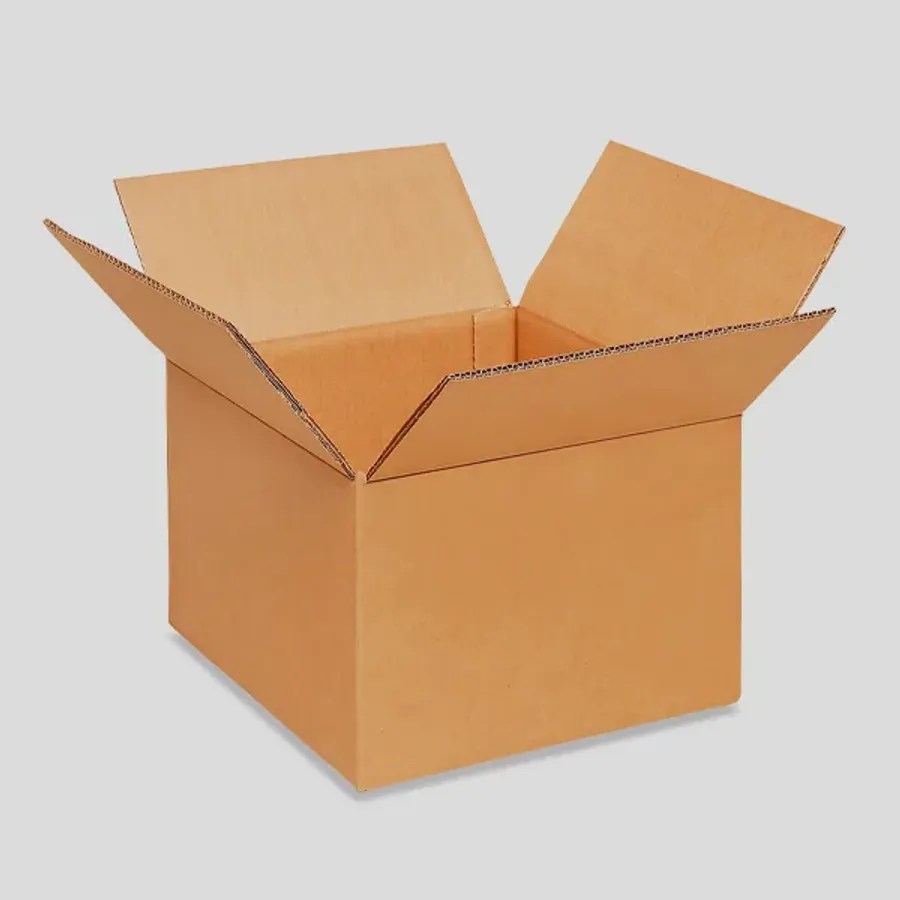
Many of them started life in inches. Take the 12 × 9 × 6 inch carton. In metric it is about 305 × 229 × 152 mm, and it is still one of the most asked-for parcel boxes in Britain.
Because we make every box to order, you are not limited to these sizes. They are a useful starting point, though, and the table below shows where each one fits.
Metric sizes have taken over in most of the trade, but people still ask for boxes by their inch size. We work in either, and the proof always shows the millimetre figures we will cut to.
Common UK box sizes at a glance
All sizes are inside measurements, given as length × width × height. Treat them as typical examples, not fixed stock sizes.
| Inside size (mm) | Inches (approx.) | Often used for |
|---|---|---|
| 102 × 102 × 51 | 4 × 4 × 2 | Jewellery, samples, small cosmetics |
| 152 × 152 × 152 | 6 × 6 × 6 | Mugs, candles, small plants |
| 229 × 152 × 102 | 9 × 6 × 4 | Small parcels, phone accessories |
| 305 × 229 × 102 | 12 × 9 × 4 | Books, folded clothing, gift sets |
| 305 × 229 × 152 | 12 × 9 × 6 | General online orders |
| 310 × 220 × 50 | 12.2 × 8.7 × 2 | A4 documents and catalogues |
| 380 × 290 × 260 | 15 × 11.4 × 10.2 | Office files and archive storage |
| 457 × 305 × 305 | 18 × 12 × 12 | Bulk stock and kitchenware |
| 457 × 457 × 457 | 18 × 18 × 18 | Bedding, cushions and house moves |
| 600 × 400 × 400 | 23.6 × 15.7 × 15.7 | Large removal and storage cartons |
Small box sizes for posting
Small boxes are where size matters most for postage. A parcel that is slim and light usually costs less to send than one that is only a little bigger.
For jewellery, cosmetics and samples, inside sizes from about 80 × 80 × 30 mm up to 180 × 130 × 60 mm cover most needs. Keep the height as low as the product allows.
Thin E flute board, about 1.5 mm, keeps small boxes neat and light. Our small cardboard boxes made to size are usually cut from it.
Shoe boxes sit at the top of this group. An adult shoe box is often around 330 × 190 × 110 mm inside, and a child's around 250 × 150 × 90 mm. Both shapes also suit gift sets and small kitchen items.
Medium sizes for online orders
Most online shops settle on two or three medium sizes between 250 × 180 × 80 mm and 350 × 250 × 150 mm. Those sizes take clothing, books, homeware and gift sets.
Pick a set that nests your best sellers with little spare room. If one product needs its own size, it is usually worth having made rather than padding a bigger box.
A paper-sized box is handy too. A4 sheets are 297 × 210 mm, so a box of about 310 × 220 mm inside will take A4 paperwork, prints and catalogues flat.
Write down which products go in which box and keep the list by the packing bench. It saves guessing when a new member of staff packs orders, and it shows you quickly if a size is hardly used.
Avoid boxes that only just fit two items side by side. A few millimetres of slack lets the goods rub in transit, while too little means a tight squeeze at the packing bench.
Large and removal box sizes
Large boxes start at around 450 mm on the longest side. Removal firms and households tend to use three sizes: a small box for books, a medium box for kitchenware and a large one for bedding.
Keep heavy things in small boxes. A 450 mm cube filled with books can weigh over 25 kg, which is too heavy for one person to lift safely. Fill the large boxes with light, bulky items instead.
For anything above about 15 kg, choose double wall BC board, around 7 mm thick. Most of our big cardboard boxes for moving house use that board.
A sensible removal set is three sizes in roughly equal numbers, plus a handful of wardrobe or flat boxes for mirrors and pictures. Tall, narrow boxes are useful for lamps and rolled rugs.
Sizing boxes to fit a pallet
If boxes travel on pallets, size them to the pallet footprint. A UK pallet is 1200 × 1000 mm and a Euro pallet is 1200 × 800 mm.
Boxes that divide evenly into those sizes stack tightly with no overhang. A 600 × 400 mm box, for instance, fits four to a layer on a Euro pallet. Overhanging boxes lose strength at the edge and are easily crushed.
On a UK pallet, a 500 × 400 mm box fits six to a layer, in two rows of three. Nothing overhangs on either side. Check your own sizes against both pallet types before ordering a large run.
Keep stacks below about 1.8 m including the pallet, unless your warehouse says otherwise, and put the heaviest boxes on the bottom layer.
How to choose the right size, step by step
Follow these steps before you order. Our full guide on measuring for the right box size covers each step in more detail.
- Measure the item at its longest, widest and tallest points.
- Add packing space: 5 to 10 mm per side for sturdy goods, 30 to 50 mm for fragile ones.
- Decide which face the box opens on, as that side sets the height.
- Write the result as inside length × width × height in mm.
- Check whether a slightly lower height would drop the parcel into a cheaper postage band.
- Pick the board, then ask for a quote and a free proof.
Inside sizes and outside sizes
Box makers quote inside sizes because that is the space your goods need. The outside is bigger by the board thickness on every side.
With E flute the difference is small, about 3 mm per dimension. With BC double wall it is about 14 mm. That matters when the box has to fit a shelf, a locker or a postage size limit.
Our guide to corrugated flute thicknesses in millimetres lists each board so you can work out the outside size.
Here is a worked example. A box of 300 × 200 × 100 mm inside in BC double wall measures roughly 314 × 214 × 114 mm outside. In E flute the same box is about 303 × 203 × 103 mm.
Sizing mistakes to avoid
A few simple errors account for most boxes that do not fit. Check your figures against this list before you send them.
- Giving outside sizes when inside sizes are needed
- Mixing up width and height on a box that opens on the end
- Measuring the product but forgetting the wrapping
- Rounding inches to whole numbers before converting
- Choosing a box much bigger than the goods and filling the gap
- Forgetting that double wall adds about 14 mm to each outside size
How many box sizes should a business keep?
Fewer than you might think. Each extra size means another stock pile, another proof and a shorter run, which pushes up the price of each box.
Most small online shops manage well with three sizes: one small, one medium and one large. Busy shops with a wide catalogue might keep five or six. Check your sales for the last three months and group products by the box they need.
If a product only sells a few times a month, pack it in the next size up with an insert rather than ordering a box just for it. Save made-to-measure sizes for your best sellers, where the fit pays back on every parcel.